RCM DIRECTOR
Portfolio exposure at a glance
Aggregated model candidates by payer, service line, and quarter. Use the view to decide where human review starts; it does not state booked or recoverable revenue.
Agree one historical claim set and the data terms first. ClaimAct then applies its illustrative 3–8% model range, returns a review queue, and delivers a findings report before any subscription is discussed.
ClaimAct reviews an agreed historical inpatient claim set and asks which encounters merit human CDI review. The 3–8% range shown here is an illustrative model assumption, not an observed result or a recovery promise. The pilot tests the model against your scoped data and returns the findings for your team to review.
ClaimAct surfaces the same review hypothesis from four angles. Each role sees the slice that maps to the decision they own. Local preview processing does not transmit the file; your team still decides whether and how to share any export under its own policies.
Aggregated model candidates by payer, service line, and quarter. Use the view to decide where human review starts; it does not state booked or recoverable revenue.
Every flagged encounter with the DRG that was billed, the model candidate, and a review reason. The candidate is a prompt for human review, not a coding decision.
525 code IR-DRG denial library with the exact Shafafiya rule cited for each flag. Trace any decision back to its source. No black box, no surprise findings.
A modelled review amount per quarter, clearly separated from booked or recovered revenue. Your team decides which candidates survive clinical, coding, and compliance review.
Walks each scoped historical claim against the ruleset. Surfaces candidate encounters for human review and ranks them by modelled dirham impact; it does not determine what documentation supports.
Expected Mean Value queue for the coding team. Routes flagged claims by modelled value and review effort, not by submission date. Values are prioritisation aids, not recovery forecasts.
High Trim Length of Stay anomalies. Flags encounters that crossed the modelled trim point for human review; it does not determine billing eligibility or recovery.
Cross sectional view across payers and service lines. Tells the RCM director which clinical units, which payers, and which quarters carry the most unrealised severity. Print to PDF for the board pack.
The only public paid offer is a one-time 30-day pilot on one agreed historical claim set. We agree the scope and data agreement before any claim data is transferred. ClaimAct then delivers a findings report and workflow demonstration before we ask whether you want to continue.
Thirty days on an agreed historical claim set. No auto-renewal and no subscription starts from the pilot checkout.
Standard recurring access may be offered only after the pilot findings report is delivered and received. It requires a new, explicit opt-in.
Enterprise recurring access is a separate decision after delivered findings. It never starts automatically from the pilot.
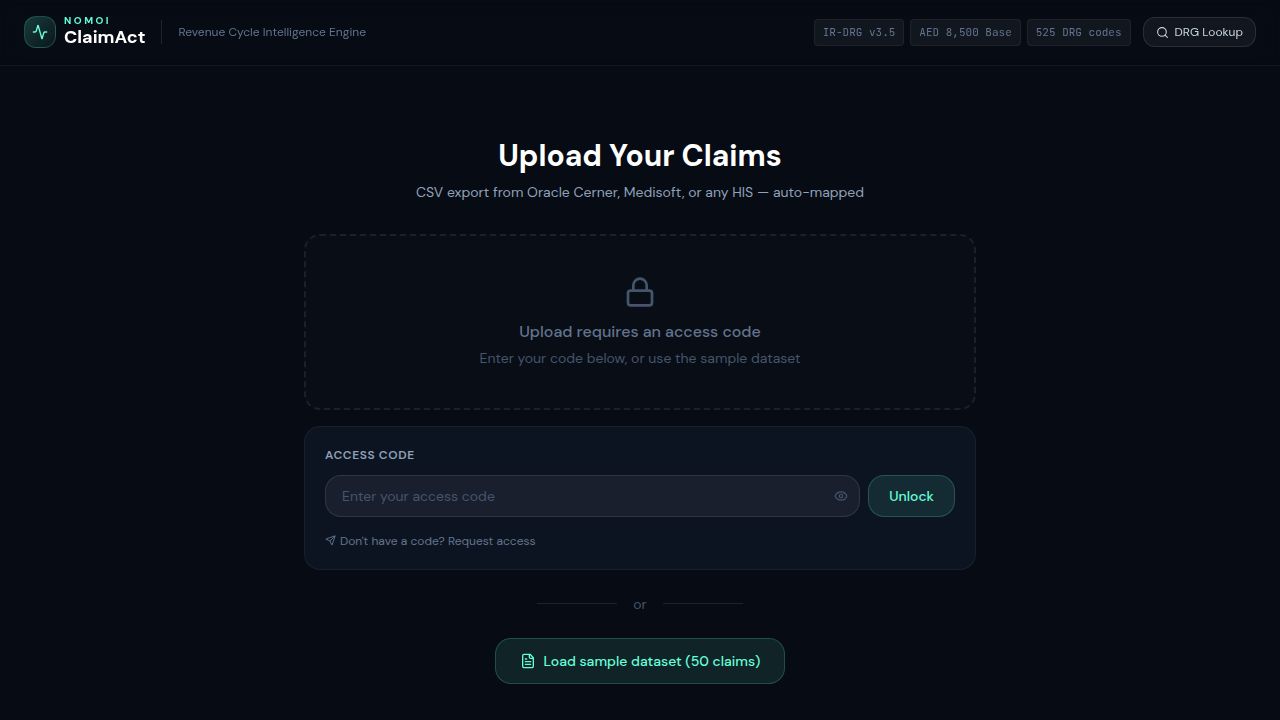
ClaimAct's local preview engine and current 525-entry ruleset run in the browser tab. A paid pilot starts only after the historical claim-set scope and data agreement are agreed. No claim file should be transferred to us before that gate is complete.
Define the historical claim set, required fields, transfer method, review boundary, and data agreement first. Do not transfer claim data before this step is complete.
Each scoped claim is scored against the current IR-DRG v3.5 ruleset and its DRG-family model. Output remains a review queue, not a final coding or recovery decision.
Shadow Leakage, EMV Dispatch, HTLOS Monitor, and Portfolio Scanner form the workflow demonstration. Your team reviews model candidates and their stated limitations.
The pilot closes with the findings report and workflow demonstration. Only after delivery may we offer recurring access; continuing requires a separate explicit opt-in.
AED 7,500 once for a 30-day pilot. Scope and data agreement come before data transfer. You receive the findings report before any subscription ask. The pilot never auto-renews.
ClaimAct is built for inpatient revenue cycle teams operating under DOH Shafafiya IR-DRG v3.5 (effective November 2025). The audit logic is portable to other DRG regimes on request. Claim data never leaves the device. We are a small team in Abu Dhabi and we work directly with the people running the queue.
Reviews from people using NOMOI products, left through Vouch after real use.